
HOME
WELCOME TO THE
OFFICE OF GOVERNMENTAL RELATIONS
In the News...
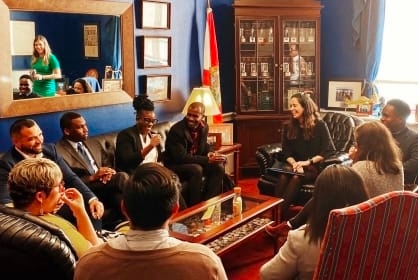
President Rosenberg leads University Presidents at Pell Grant event on Capitol Hill, click here.
To read President Rosenberg's Op-Ed in the Miami Herald regarding Pell Grants, click here.
WASHINGTON
Although Congress and the President have now enacted a federal budget that maintains the Pell Grant maximum at $5,550 for the 2012-12 academic year, a set of changes to Pell eligibility were enacted that will affect students currently receiving grants.
These amendments include limiting Pell grants to a total of 12 semesters, not 18, as in the past. Additionally, students currently receiving less than 10% of the maximum grant ($5,550) will lose eligibility. Finally, the threshold maximum family income that would automatically qualify a student for the maximum grant from has been reduced from $30,000 to $23,000.
It is projected that these changes would result in over 1,110 students losing Pell Grant eligibility entirely and an additional 1,500 FIU recipients will see their grants reduced. Currently, over 17,000 FIU students receive Pell Grants, over 48% of our undergraduate student population, 78% of those are also first generation in college. A more complete profile is included on our governmental relations site.
Advocating to protect Pell Grants has been a top priority for our Federal Relations team and advocates like Student Government presidents Denise Halpin and Patrick O’Keefe who had personally advocated to our Congressional Delegation. President Rosenberg also wrote a recent op-ed on this issue. Click here
Also in this year’s appropriations, minor reductions were made to Department of Education funding for Hispanic-Serving Institutions (H-SI) while H-SI funding at the Department of Agriculture was maintained. Funding for the National Institutes of Health was also increased. These three agencies are just a few that are critical to FIU’s research initiatives.
Our team will continue to review the impact of this year’s appropriations actions and advocate with the higher education community as the FY13 appropriations process begins.
At the same time, we are also advancing our legislative priorities that can serve as a catalyst for growing South Florida’s economy. Of immediate importance this Summer is advocacy for key, funded research designations; protecting financial aid resources; and positioning FIU to succeed in new competitions for Science, Technology, Engineering, and Math Education (STEM).
TALLAHASSEE
In addition to what you've read in the newspaper, many have been asking, "How did we do in Tallahassee?" As you might expect, the precise answer is a complex one. FIU's finance team is scouring over the details as they become available. Many provisions of law were included in what are known as the budget implementing and conforming bills, so the details are critical.
The good news is that in the final round of budget negotiations, we were able to secure the full incremental funding requested for the FIU and UCF Colleges of Medicine (COM). Each year FIU needs a smaller incremental amount to reach the state support milestone envisioned by our 10-year LCME accreditation plan, but each year has its own challenges. A lot of effort went into keeping our COM plan on track and we appreciate the support of all involved. In another tough year with a $4 billion state revenue shortfall, receiving an additional $2 million recurring for our College of Medicine was our victory.
Overall, the State University System fought to minimize cuts in operational funding. We would like to have obtained recurring fuding to replace last year's $13 million in one-time federal stimulus funds. However, with a major state revenue shortfall, restoration of federal stimulus with recurring state dollars really wasn't possible.
Starting with a reduced base for 2011-12, recurring General Revenue for FIU operations was cut $13 million or a little more than 8% from this account. This cut was offset by a small $2.7 million increase in state lottery funds, and a mandated 8% tuition increase supplemented by an expected 7% tuition differential increase. The precise amount of money which the university will yield from this $18 per credit hour increase is yet to be determined. Furthermore, 30% of the differential tuition increase will be used for student financial aid, not operational or program support. The bottom line could result in a modest increase in revenue applied to every growing obligations.
But budget stories are never simple. In in the name of pension reform, faculty and staff will now be required to contribute 3% of their salary to their retirement. The univeristy will not be receiving the equivalent 3% the state previously contributed. This new requirement translates into a 3% paycut, on top of no state-funded salary increase.
We are providing this highlights report even as we prepare the more detailed post-session report. This final end of session report will provide links for easy access to a multitude of details needed for university operations in the coming year.
How this budget translates into funds available for university operations will be the topic of the President's Budget Town Hall meeting May 19th at 2:00 pm in the MARC Pavilion.
Session will begin in January next year. We have already started planning for it.
For more detailed information on session results, please click here.